
Pet Urine Rug Cleaning El Paso
Full-immersion rug washing at our own plant — not a wand in your living room.
He’d already tried twice before calling us to pick up his rug.
Not long ago, we went to get a rug (the rug in the photo) from a customer whose dog — we saw him while at the house — had, in his own words, “done a real number on it.” It wasn’t a rare piece — it was a synthetic rug, nothing close to the hand-knotted rugs that make up most of what comes through our shop. He’d already paid another company to “clean” it, in his home, the same way just about every company in town handles a pet urine call. That didn’t work.
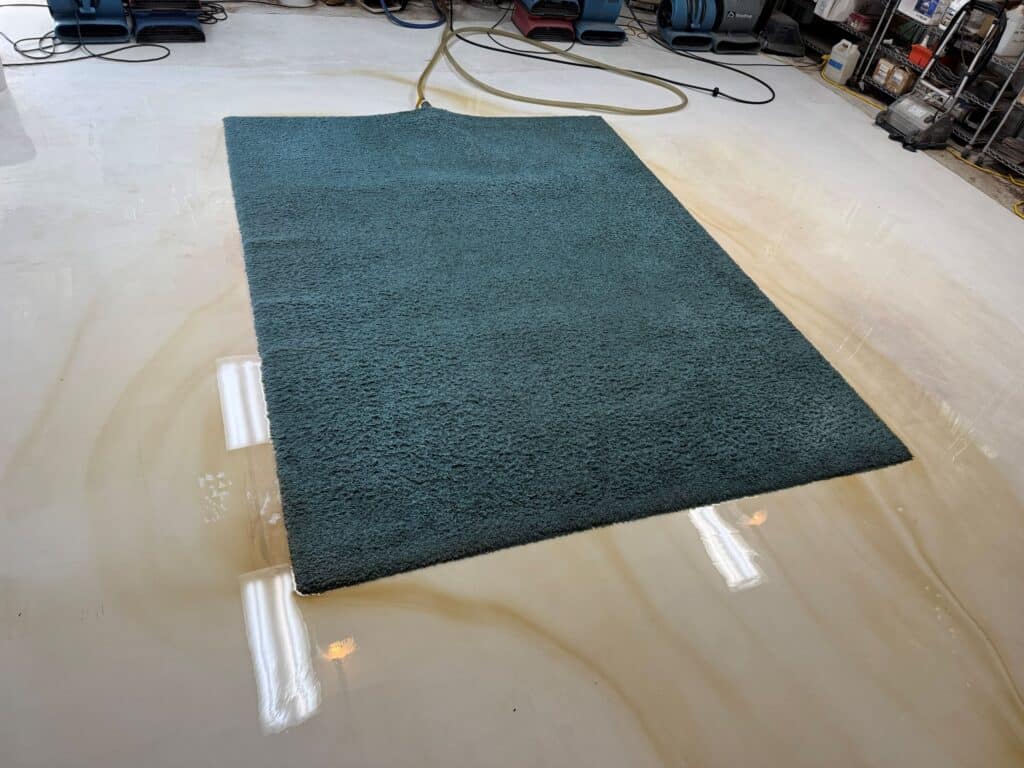
If anything, the rug smelled worse than before. So he did what lots of people try next: he dragged it into his own backyard, hosed it down, and tried “cleaning” it himself. The rug was so heavy with water he had to let it drip-dry for a full day in the sun. And it still smelled bad afterward.
By the time he called us, he’d already paid once and spent a full day of his own time on it, and neither had worked. When we talked about price, he didn’t hesitate. He told us he liked the rug and wanted it fixed.
This page exists to walk you through our “Pet Urine Rug Cleaning El Paso” process — what actually causes the smell, why the first attempt usually fails, and how we decide whether a rug is worth saving.
Rugs Aren’t Carpet — We Actually Love Our Rugs and Want to Save Them
We see it constantly, and not just from people with hand-woven rugs. Lots of rugs we clean came from Home Depot or Lowe’s — nothing rare about them at all — and their owners still call a specialist instead of renting a machine, because they like the rug and it goes with the decor. The pattern holds in the other direction too: the more a rug is actually worth — especially if it’s been passed down from a parent or grandparent — the more its owner is inclined to save it and protect it rather than replace it.
That’s why “just replace it” is such an unsatisfying answer when a rug you like has pet urine accidents on it. Getting urine out of a rug is something we can do effectively every time. The real question on any hard case is never whether the urine can be removed — it’s whether the rug itself or its dyes are strong enough to survive the process (and the large majority are). More on that further down.
What Pet Urine Actually Does to a Rug
Fresh urine starts out roughly neutral pH. It doesn’t stay that way. As it breaks down, it turns highly alkaline, and that shift is what starts damaging the rug and its dyes.
Wool is a protein fiber — chemically closer to your own hair than to nylon carpet. Alkaline conditions attack protein fibers directly, which is why a wool rug that’s been urinated on repeatedly starts to feel brittle and shed more than it used to.
Dyes are also affected, and they go in a pattern: according to the Carpet and Rug Institute, blue dyes break down before red and yellow ones, which is why urine damage on a beige rug often shows up as an orange or yellow bloom instead of a dark stain, and why a Persian or Oriental rug’s indigo blues can fade in exactly the spot where the accident happened.
Underneath all of that, most hand-knotted rugs are built on a cotton foundation, and cotton rots. Repeated urine exposure weakens that foundation, and a weakened foundation is what eventually shows up as a split along a fold line, long after the rug looks fine on the surface.
Why the Smell Keeps Coming Back
Urine leaves behind salts that don’t dissolve the way the original liquid did. Those salts sit dormant in the foundation until humidity brings them back to life — which is exactly why a rug can seem fine in April and smell like a kennel as it gets hotter, especially once El Paso’s monsoon season rolls in. It’s also why spraying a store-bought treatment on top so often makes things smell worse: you’re adding moisture directly to the deposits that moisture reactivates.
Why the First Attempt (or Two) Usually Doesn’t Work
The customer from the story above isn’t unusual. Most people try something before they call a specialist — a store-bought spray, a rented machine, or a company that treats a rug the same way it treats wall-to-wall carpet, in the customer’s own home. Here’s what actually goes wrong.
Dissolving urine takes real time — sometimes days — and a soaking-wet rug can’t sit on somebody’s living room floor that long. We don’t use enzymes on rugs. Enzymes can damage wool, so instead we use a urine pre-treatment made specifically to dissolve urine crystals — sometimes applied just to the affected spots, though more often we treat the entire rug so nothing gets missed.
How long that takes depends entirely on how much urine is actually in the rug: a single accident might dissolve in a few hours, while a rug marked in the same spot over and over can take days. We let the rug tell us when it’s ready, not a schedule. That’s simply not something that can happen in a house — the rug has to lie flat, fully saturated with treatment, for as long as it takes. It’s not something we could even do in our own home. It only works on a floor built to take it.
Most store-bought and in-home urine treatments only work from one side, and really only belong on synthetic rugs. Nearly all of them are enzyme-based, and enzymes can damage wool, silk, and cotton — so using one on a natural-fiber rug can do more harm than the urine itself.
Even setting that aside, there’s a mechanical problem: whatever a wand pulls up has to travel back through the pile to get out, and whatever it doesn’t pull up stays in the foundation — or gets pushed further down into the carpet, tile, or hardwood the rug is sitting on. Now the smell has two sources instead of one. (If your accident happened on wall-to-wall carpet rather than a rug, our dedicated pet urine odor removal process handles that differently — this page is specifically about rugs.)
There’s no formal certification specifically for rug cleaning, which is exactly why so many companies get it wrong. Carpet cleaning has some industry credentials behind it; rug cleaning, to our knowledge, doesn’t. That means the difference between a real rug specialist and someone running carpet equipment on a rug comes down entirely to who trained them and how. Our own process was taught directly by a mentor with more than 20 years of hands-on rug cleaning experience — not a weekend course. A lot of companies advertising “rug cleaning” in El Paso are really just a carpet cleaner with a different word on the invoice.
Here’s a test you can use on anyone, not just us: if a company treats a pet urine odor problem without taking the rug off-site, the smell needs to be gone before the technician leaves your house. Not mostly gone. Not “should fade in a day or two.” Gone. If it isn’t, ask for a refund — because if the odor is still there when they walk out the door, it’s still there tomorrow.
For a rug specifically, we hold ourselves to a stricter version of that same test, and we test it at the point where a rug actually smells the worst — not the point where it’s easiest to pass. A rug smells strongest while it’s still wet, because the evaporating water carries the odor with it; that’s the same reason a rug can smell worse during monsoon season than on a dry day.
About 20 to 30 minutes after we start drying — long enough for that humidity to fill the shop — is when any urine still left in the rug shows up. If it’s not there by then, it’s not going to reappear once the rug dries; if it is there, drying it further won’t fix it. That’s the standard we used on the rug from the story above, and every rug that comes through our shop.
How We Handle “Pet Urine Rug Cleaning El Paso” at Our Own Washing Plant
We don’t clean rugs in your living room. Every rug goes to our dedicated rug washing plant — the only one in El Paso — where it can be washed all the way through instead of just across the surface. Here’s what actually happens:
Inspection and mapping. Before we do anything, the rug goes under UV blacklight. Urine fluoresces, so we can see the real extent of the contamination instead of just the spot you noticed. Most people are surprised by how much larger the affected area turns out to be.
Fiber and dye testing. We identify the fiber and test every color to see whether it’s going to move once the rug is wet, and how much — testing is diagnostic, it tells us what a dye will do, not whether the rug is worth doing. Dyes move for one of two reasons: some rugs are over-dyed on purpose and the excess color was never bonded to the fiber to begin with, or the dye itself was a weaker recipe that never bonded fully even though the color looked right. Either way, what we do with that information — rinse it, strip it, or walk away from it — comes from training and experience, not from the test itself.
Dusting. Dry soil comes out first, before any water touches the rug. Wash a rug without dusting it first and you turn the grit already deep in the pile into mud.
Urine pre-treatment and full immersion washing. The rug gets treated with our urine pre-treatment solution — the same process described above, left on for however long it actually takes to dissolve the urine crystals, whether that’s a few hours or a couple of days — and then the entire rug is washed through its full thickness, not across its surface. This is the step a rug plant can do that a carpet cleaner with a van never can, and it’s the only step that actually removes urine from the foundation.
Controlled rinse and pH correction. Wool needs to come back to a slightly acidic pH to stay healthy. Getting it there is what keeps the fiber from sitting in the alkaline state that damaged it in the first place.
Controlled drying. The rug dries flat, with airflow, on a schedule, in a space built for it — not on your living room floor. Even, fast drying is what prevents further dye migration and mildew, and it’s the other half of the process nobody can replicate at home.
Final inspection, same as the first. We check the rug under blacklight again before it goes anywhere. If anything remains, it gets re-treated before it comes back to you.
Pickup, Drop-Off, and How Far People Go to Get a Rug to Us
Most of the rugs we clean locally, we pick up and deliver ourselves — very few El Paso and Las Cruces customers drop off at the shop, though we’re glad to take them either way. Pickup and delivery is standard throughout greater El Paso out to Las Cruces, NM and Fabens, TX. Beyond that radius, we still pick up — it just carries an additional charge to cover the distance.
What might surprise you: we regularly get rugs from Marfa, TX, Alpine, TX, Van Horn, TX, Deming, NM, Hatch, NM, and Silver City, NM — each two to three hours away. Almost all of those come to us as drop-offs, because the owner decided a specialist rug plant was worth the drive. We think that says something real about how people feel about their rugs, and it’s exactly the point this whole page is making.
Once we have your rug, our goal is to have it back in your hands within 7 to 10 days. Like any shop, some weeks are busier than others, but that window is what we aim for on every job, including pet urine work.
What It Costs
We’re not going to guess at a number here, because a fair one depends on the rug’s material, its size, and how much of it is actually affected — the same reason we inspect every rug under blacklight before quoting anything. Our “Pet Urine Rug Cleaning El Paso” pricing runs through the same Get A Quote tool as our carpet and upholstery pricing: it prices rug washing by material, plus pet urine treatment as its own line item, and gives you a real number in about a minute.
If your rug turns out to need an in-person look — most urine cases do, once we know how far the contamination actually spread — we’ll tell you that too, honestly, before you commit to anything.
Severe, long-untreated contamination on a large rug can occasionally need a second or even third wash cycle, but that’s done at the same price. If that’s the case, we tell you before we start, not after, since it will take longer.
When a Rug Can Be Saved — and When It Honestly Can’t
To be clear about what’s actually in question: removing the urine itself isn’t the uncertain part. We can dissolve and extract urine from a rug effectively every time. What we can’t always predict ahead of time is whether the rug itself — as a physical object — is strong enough to survive the process, especially on a piece that’s already been weakened by years of contamination or a rotted foundation. That’s the real, honest limit, and it’s a different question from whether we can get the smell out.
We’d rather turn a job down than take money for a rug that won’t hold up. And “it can’t be saved” is worth being skeptical of when it comes from a company that never actually tried the full process to begin with.
Very saveable:
- Recent accidents, even large ones
- Contamination confined to the pile and upper foundation
- Rugs with dye migration — stripping the moved color back out is a normal step in the wash and succeeds in the large majority of cases
- Synthetic rugs, which resist both dye damage and fiber damage well — like the rug in the story above
Mostly saveable, with honest expectations:
- Older contamination where dye damage has already become visible. The urine and odor come out; the color change is permanent, though it can sometimes be corrected by hand through color restoration
- Repeated accidents in the same spot over a year or more
Usually not worth saving:
- A foundation that’s rotted enough that the rug is splitting or crumbling at the contaminated area
- Contamination covering most of the surface on a rug whose value is already below the cost of the work
- Some machine-made rugs with a latex adhesive backing — since latex is water-based, prolonged wet exposure can break down the bond and delaminate the layers
Cat urine deserves a specific note here — not because the odor is any less removable, but because of what getting it out requires. Cat urine is more concentrated than dog urine, so a heavily, repeatedly marked rug needs a longer soak in pre-treatment to fully dissolve it.
That extra time wet is exactly the condition that turns a marginal foundation, an already-fragile dye, or a latex adhesive backing into a rug that doesn’t survive the process — latex is water-based, so it’s exactly the kind of thing prolonged wet time works against. So on a cat urine job, we look harder at those same three things before we start — not because the urine is a bigger problem, but because it asks more of a rug that may already have one of them.
If we inspect your rug and conclude it can’t be saved, we say so, and we don’t charge you for the inspection.
Professional Rug Cleaning in El Paso, Not a Side Service
Fibercare has been cleaning rugs for El Paso families for over 30 years. We’re not a carpet cleaning company that also does rugs when asked — rugs go to a dedicated rug washing plant, the only one in El Paso, where they’re washed through, dried flat, and inspected before they come home. That’s true whether the rug came from three blocks away or three hours away in Marfa, TX.
For pet owners, we handle the rug and the room it lives in. The rug that got urinated on is rarely the only thing that did, and treating one without the other is a common reason the smell survives.
Call (915) 820-2656 for a free inspection, or start with our Get A Quote tool to schedule your “Pet Urine Rug Cleaning El Paso” appointment. Send a photo of the rug and we can usually tell you what you’re dealing with before we ever pick it up.
Frequently Asked Questions
Can pet urine be completely removed from a rug?
Yes — if the rug is washed by full immersion rather than surface cleaned. Urine soaked into the foundation can’t be removed with a topical treatment. Cat urine and contamination that’s gone untreated for years simply take longer to fully treat; the outcome isn’t in question, just the time it takes.
How do I know if a company actually got the urine out, or just covered up the smell?
If the job was done in your home rather than off-site, the smell should be gone before the technician leaves — not “should fade in a day,” gone. If it isn’t, ask for a refund. For a rug we take to our plant, our standard is stricter: about 20 to 30 minutes into drying, once the shop fills with the humidity coming off the rug, any urine that’s still there makes itself known. That’s actually the toughest point to hide a problem — a rug smells worst while it’s evaporating, not after it’s dry — which is exactly why we test it there instead of waiting.
Why does my rug only smell when it’s humid?
Urine leaves salt deposits in the rug’s foundation that stay dormant until they absorb moisture from the air. When El Paso humidity climbs during monsoon season, those deposits reactivate and the odor returns. A smell that comes back seasonally is a sign the urine was never actually removed the first time.
Will cleaning ruin the colors in my rug?
Some color movement during washing is actually normal — it happens on plenty of rugs, professionally cleaned or not. Two things usually cause it: some rugs are over-dyed on purpose, and the extra dye that never bonded to the fiber has nowhere to go but out; other times the dye itself was a weaker recipe that never fully bonded, even though the color looked right.
Testing before we start tells us whether a rug’s dyes are likely to move and roughly how much — it’s diagnostic, not a guarantee either way. A dye that’s going to move keeps moving for as long as the rug stays wet, which is why fast, controlled drying matters: it cuts off migration in progress.
Most color movement rinses cleanly off the rug on its own. When it lands on another color instead — ivory picking up a pink tint, for example — stripping it back out is a normal part of finishing the rug, not a sign something went wrong, and it works in the large majority of cases.
It isn’t a 100% guarantee — nothing in rug cleaning is — which is exactly why we’re already looking for that risk during inspection, before a rug ever gets wet. Pre-screening catches most of it, but nothing catches all of it; on the rare rug where a color still doesn’t fully strip clean, we tell you exactly where things stand. Urine itself can also damage dyes before a rug ever reaches us, so some color change can predate the cleaning entirely.
How much does pet urine rug cleaning cost in El Paso?
It depends on the rug’s material, size, and how much of it is actually contaminated, which is exactly why we inspect under blacklight rather than guess over the phone. Our Get A Quote tool gives you a real starting number in about a minute.
Should I clean the floor under the rug too?
Almost always. Urine that soaked through the rug went into whatever was underneath it. Clean the rug and leave contaminated carpet, padding, tile, or hardwood in place, and the smell comes back — and the clean rug reabsorbs it.
Do you pick up rugs outside El Paso?
Yes. Pickup and delivery is standard throughout greater El Paso out to Las Cruces, NM and Fabens, TX at no extra charge. Beyond that radius — we regularly get rugs from as far as Marfa, Alpine, and Van Horn, TX, and Deming, Hatch, and Silver City, NM — pickup is available for an added fee, though most customers from that far out choose to drop the rug off themselves.
A rug you like is worth fixing, whatever it cost. If yours has a pet urine problem that’s already survived one cleaning attempt, or you just don’t want to risk making it worse trying it yourself, get in touch before you decide it’s beyond saving.